
A sheave only makes a pull easier when the line sits in the groove at the right angle. Get that wrong and you're cranking for twice the effort. Wrecker Rick finds this out the hard way, wrestling a spare tire onto a newly bought military truck, and the fix he lands on is the same principle behind every fairlead on a winch and every snatch block in a recovery kit. Understand it now, before you rig anything under load.
- Rick's cranking a heavy spare tire onto a military truck by hand, standing on a ladder to do it, until he notices the cable's routed wrong through the hoist's sheave.
- He re-routes the cable through the sheave correctly, and the same pull turns "a lot easier." No ladder required.
- Per Grand Lifting, a line pulling at a straight 180-degree angle through a pulley can load the anchor point at nearly double the pull force; at 90 degrees it's closer to 1.4 times.[2]
- A winch fairlead does this same job on purpose: it keeps the rope or cable running straight onto the drum instead of at an angle that saws against the housing.
- A kinetic recovery rope is a different animal. It's built to stretch under load, and a stretching rope has no business running through a metal sheave the way a wire cable does.
- Murphy's doesn't sell the tire hoist Rick fixed. What the store sells is the rope and the hitch point for a straight-line recovery pull, a separate job with separate rules.
1. A heavy spare tire and a cable that wouldn't cooperate
Rick's just bought a military truck and he's trying to get it road ready before a trip. Late in the day, with the truck not fully sorted, he pulls out the spare so he can throw it on and go. It's not a small tire. "That looks heavy this morning," he says, and yeah, it fights back the way heavy things do when the hoist mechanism isn't cooperating.
He's cranking the tire up on the truck's built-in hoist, a cable-and-crank setup that lifts a spare into its mount, and something about it isn't working right. He has to stand up on a ladder just to get enough leverage on the crank. That's a lot of effort for a job that's supposed to take thirty seconds.
2. The fix: routing the cable through the sheave correctly
Rick stops. Looks at the mechanism. Catches the actual problem. Nice catch, too. In his own words: "I just noticed something. I've been going at this all wrong. There's a little shiv head right there where it looks like the cable might wrap through there." "Shiv" is trade slang for a sheave, the grooved wheel inside a pulley that a cable or rope rides through. He re-runs the cable through it a different way.
"I just noticed something. I've been going at this all wrong. There's a little shiv head right there where it looks like the cable might wrap through there. Stand by, folks."Wrecker Rick, mid-fix, "I Bought A Massive Military Truck By Accident Then Tried Driving It Across America"
Then this: "That definitely worked a lot better than the other way. You live and learn, folks." No more ladder. No more standing on a rung to horse a crank around. Same tire, same hoist, same cable. The only thing that changed is which side of the sheave the cable rides on. That's a satisfying fix to watch land.
3. Why the wrap angle changes the effort
A sheave doesn't add power on its own. What it does is change the direction a line pulls in, and where that line contacts the groove decides how much force actually reaches the anchor point versus how much gets wasted fighting the housing or binding against the wrong edge. Grand Lifting, an industrial rigging supplier, puts a number on it: "For a 90-degree angle, the force is about 1.4 times the line pull. For a straight pull (180-degree angle), the force on the anchor can be nearly double."[2] Rick's fix likely straightened out an off-angle wrap that was fighting itself. That's exactly the kind of change that turns a hard crank into an easy one.
The same source is specific about the mechanical setup that makes a sheave safe to use at all: "place the wire rope into the sheave's groove, ensuring it isn't twisted," and "the sheave groove must be the correct size and material for the rope to prevent damage and ensure safe operation."[2] A groove that's too small, or a cable riding on the wrong side of it, doesn't just cost you effort. It chews up the cable.
4. Where this shows up on a winch: the fairlead
A winch fairlead does the sheave's job on purpose, right at the front of the drum. Its entire function is keeping the cable or synthetic rope running straight as it spools in, instead of at an angle that saws against a housing edge or piles up unevenly on one side of the drum. Murphy's Gladiator winches use a 7075 aviation grade aluminum fairlead for exactly this reason. Not a cosmetic part. It's the difference between a rope that lasts and a rope that frays in one season of angled pulls. You'll notice which one you own.
Ever wonder why a $30 tow strap and a $1,000 winch both come with warnings about running a line straight? Angle is the whole game, whether it's a spare-tire hoist, a snatch block, or the fairlead on the front of your bumper.
5. Why a kinetic rope doesn't get the same treatment
This isn't a sales pitch. It's a genuine safety distinction, and it deserves to be exact. Everything above is about wire rope and cable, which is designed to bend around a sheave. A kinetic recovery rope is built to do the opposite: it's supposed to stretch, storing energy under load and releasing it to help drag a stuck vehicle free. Yankum, whose kinetic rope Murphy's sells under its own name, rates its 1" rope to "stretch up to 30% longer when being used."[3] That stretch is the entire feature.
Run that same rope over a metal sheave or a hard edge and you get the opposite of what Rick fixed. The rope's own stretching motion drags fiber against metal exactly where it's under the most tension, and that's how a kinetic rope gets cut from the inside out. A kinetic rope's job is a straight pull between two rated points: your vehicle's hitch point on one end, the stuck vehicle's rated point on the other. No pulley. No sheave. No wrap.
"When Wrecker Rick puts his name on something, you know it's built to work."Murphys Diesel Recovery Rope product page
| Cable Through a Sheave | Kinetic Rope, Straight Pull | |
|---|---|---|
| Runs through a pulley | Yes, by design | Never |
| Stretches under load | No, wire rope holds length | Yes, up to 30%[3] |
| Wrap angle matters | Critical, per Grand Lifting[2] | Not applicable, straight line only |
| Anchor hardware | Winch mount, snatch block | Rated hitch or recovery point on each end |
6. Building a rig for a straight-line pull
You don't need a winch or a sheave for any of this. A recovery rope and a rated hitch point cover the straight-pull job by themselves. The rope stretches. It does the work. The hitch point gives it a hard anchor on each vehicle, and that anchor is never a tow ball or a bare bumper.

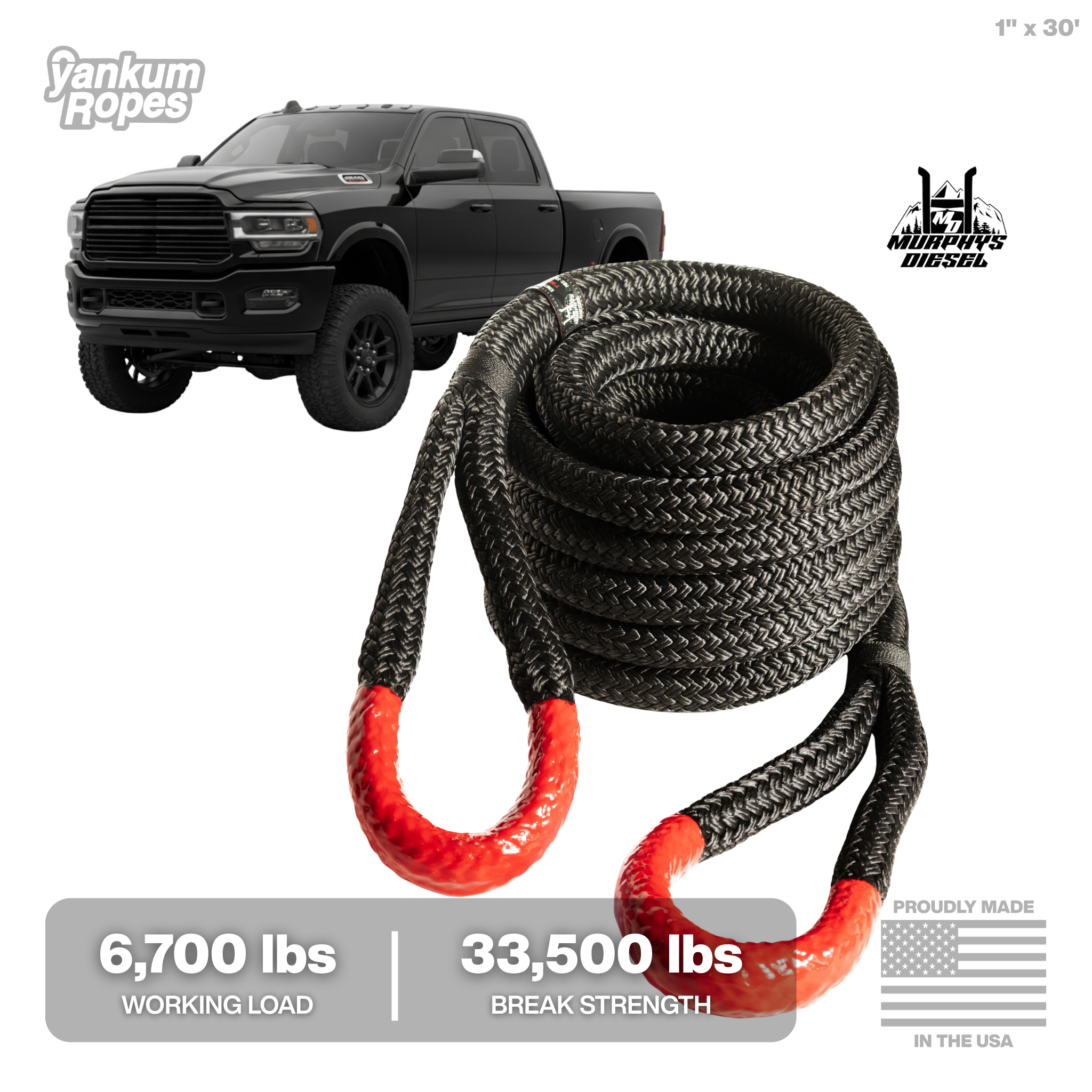
1" x 30', double braid nylon, minimum tensile strength 33,500 lbs, WLL 6,700 to 11,200 lbs. Rated for 3/4 to 1-ton trucks and heavy SUVs. Made in the USA by Yankum.

Fits a standard 2" receiver. The anchor half of a straight-pull rig for trucks and SUVs running a common hitch.
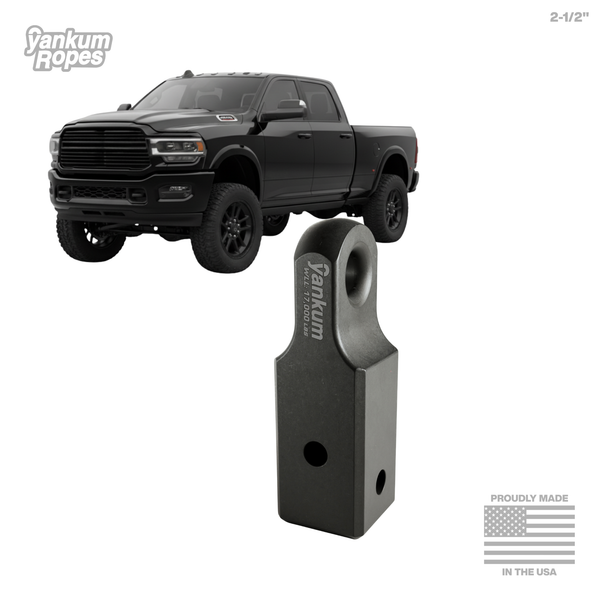
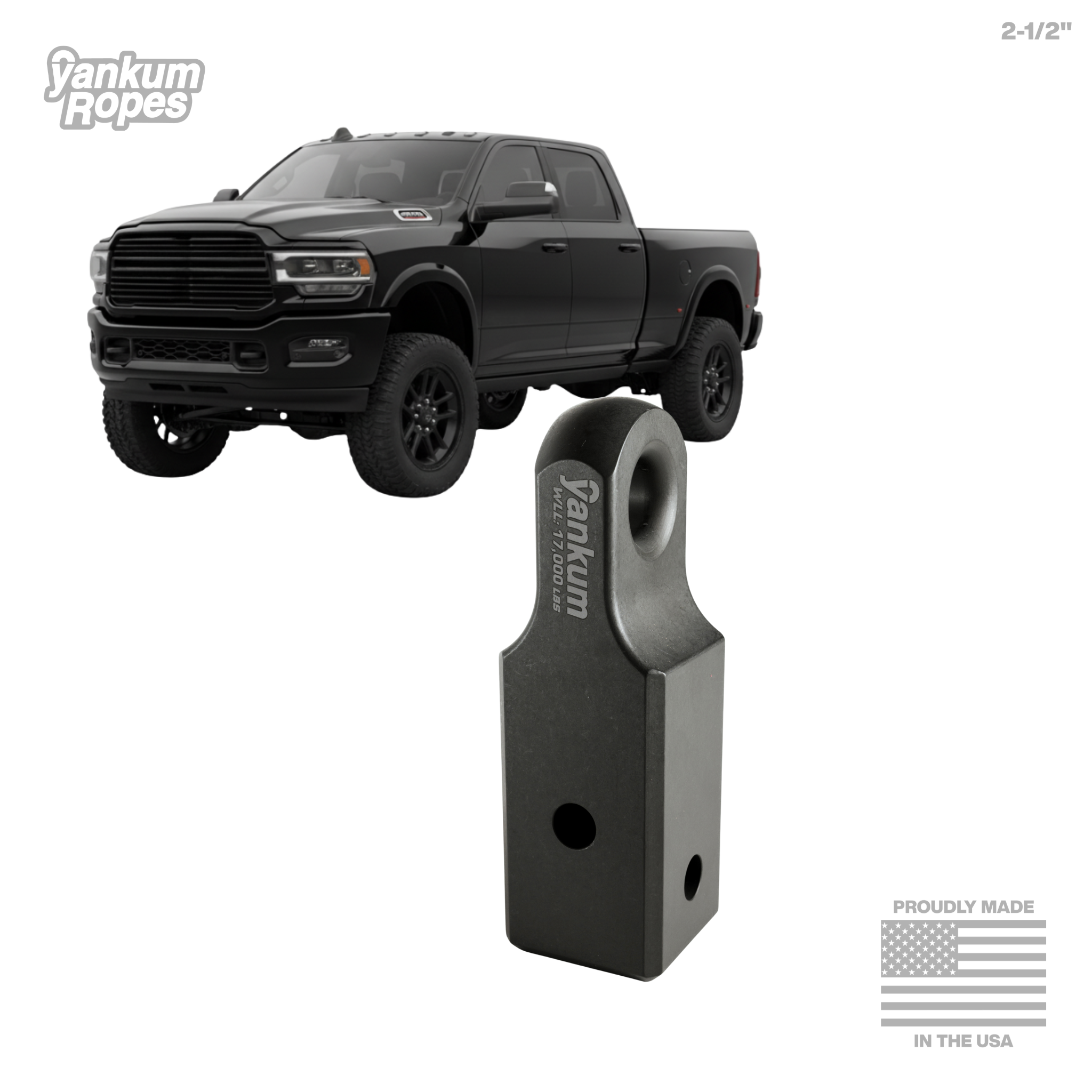
WLL 18,000 lbs at a 5:1 factor of safety. CNC machined in Idaho, 6061 aluminum, fits a 2.5" receiver.
1" x 30', 33,500 lb minimum tensile strength. The stretch-and-pull half of the system this whole article is about.

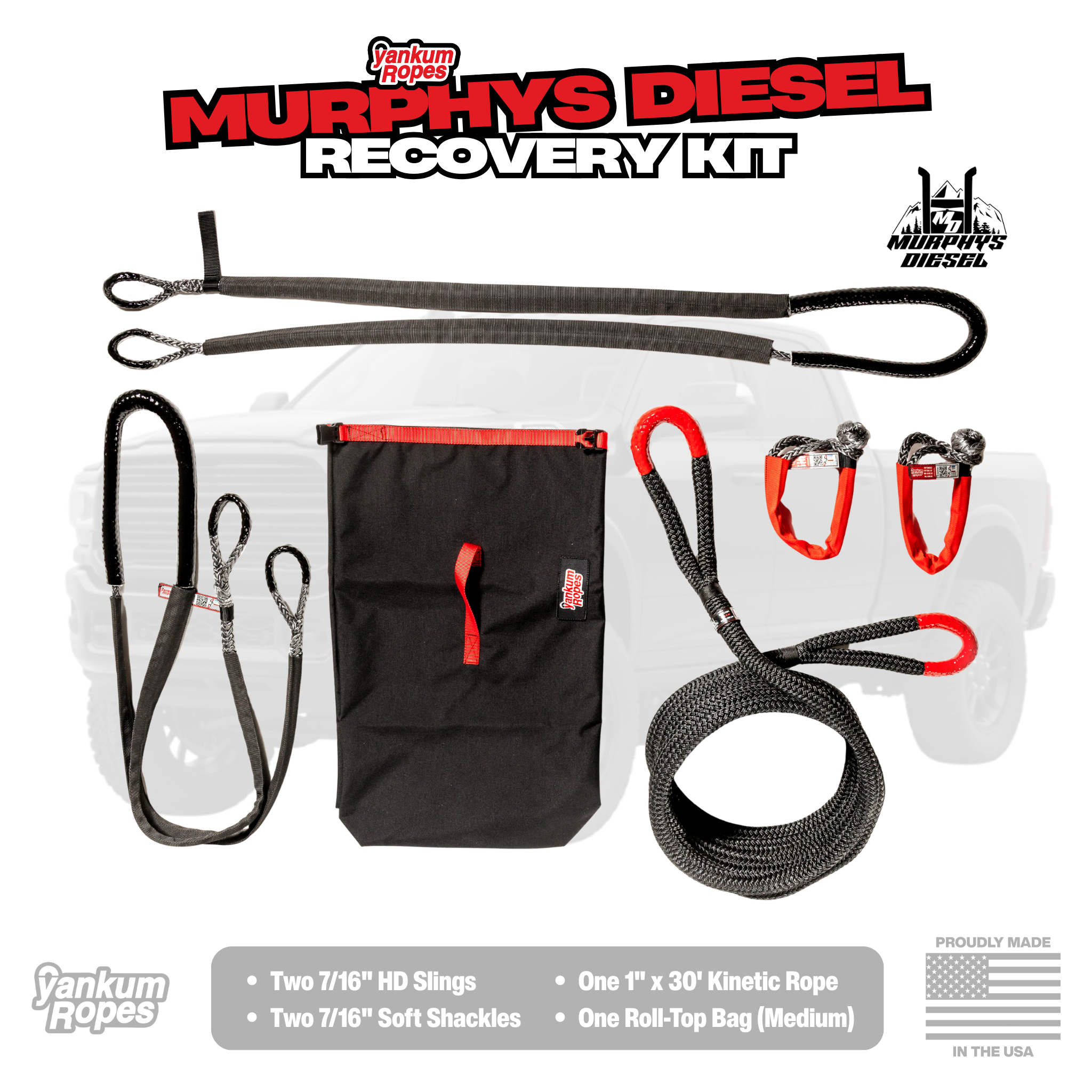
The rope above plus two 7/16" recovery slings, two 7/16" soft shackles, and a roll-top bag. Everything packed, nothing improvised.
7. Safety: cable, sheaves, and rope under tension
Anything spooling under load, whether it's a hand-crank hoist or a truck winch, can hurt you the same way. A few rules apply no matter which side of this comparison you're rigging.
These come from rigging and occupational-safety sources, not house opinion.
- Never inspect a wire cable with bare hands. OSHA's guidance is direct: "Do not inspect a sling by passing bare hands over the wire rope body. Broken wires, if present, may puncture the hands."[1] Wear gloves and look, don't feel.
- Check the groove before you load a sheave or pulley. Per Grand Lifting, the wire rope needs to sit correctly in the groove, untwisted, and "the sheave groove must be the correct size and material for the rope to prevent damage and ensure safe operation."[2]
- Never route a kinetic recovery rope through a pulley, snatch block, or over a metal edge. It's built to stretch, not to bend around hardware, and doing so risks cutting the fibers exactly where the load is highest.
- Inspect any load-bearing line before every use, whether it's a hoist cable, a winch line, or a kinetic rope. A qualified check before the pull, every time, is standard rigging practice, not an extra step.[1]
- Keep hands and body clear of a line under tension. A cable or rope that's loaded and lets go doesn't give a warning first.
Sources: [1] OSHA: Safe Sling Use, Wire Rope · [2] Grand Lifting: How to Use a Snatch Block for Industrial Lifting and Rigging
8. The bottom line
Rick's fix took him seconds once he saw it: run the cable through the sheave the other way, and a hard crank turns easy. That's not really a story about a spare tire. It's a story about how any line under load, cable or rope, only works with the machine around it, not against it.
Wire rope wants a straight, correctly sized sheave or fairlead. A kinetic rope wants none of that, just a rated point on each end and room to stretch. Mix the two up and you're either fighting a cable that's binding on itself, or cutting a rope against hardware it was never built to touch.
Sources
- OSHA, "Safe Sling Use: Wire Rope." "Do not inspect a sling by passing bare hands over the wire rope body. Broken wires, if present, may puncture the hands." Also: designate a qualified person to inspect slings and fastenings each day before use. osha.gov/safe-sling-use/wire
- Grand Lifting, "How to Use a Snatch Block for Industrial Lifting and Rigging." "For a 90-degree angle, the force is about 1.4 times the line pull. For a straight pull (180-degree angle), the force on the anchor can be nearly double." Also: "place the wire rope into the sheave's groove, ensuring it isn't twisted." "The sheave groove must be the correct size and material for the rope to prevent damage and ensure safe operation." grandlifting.com/blog/how-to-use-a-snatch-block-for-industrial-lifting-and-rigging
- Yankum, Rattler 1" Kinetic Recovery Rope product page. "Can stretch up to 30% longer when being used." Minimum tensile strength 33,500 lbs. Rated for vehicles weighing 7,200 to 10,249 lbs. yankum.com/products/rattler-kinetic-recovery-rope
FAQ
A sheave is the grooved wheel inside a pulley or block that a cable or rope rides through. It redirects the direction of a pull, and on a winch, a fairlead uses the same idea to keep the line running straight onto the drum instead of at an angle that saws against the housing.
The angle a line makes as it passes through a pulley changes how much force reaches the anchor point. Per Grand Lifting, a 90-degree wrap loads the anchor at roughly 1.4 times the line pull, while a straight 180-degree pull can load it at nearly double. A poorly angled wrap can also bind against the housing and waste effort before the load even moves.
No. A kinetic rope is built to stretch under load, up to 30% longer per Yankum's own spec sheet, and that stretching motion against a metal sheave or hard edge is exactly how the fibers get cut. A kinetic rope's job is a straight pull between two rated points, not a redirected one.
A fairlead is fixed to the front of the winch and keeps the line running straight onto the drum. A snatch block is a separate pulley you rig into the line elsewhere in the system, usually to redirect the pull's angle or add mechanical advantage. Both use the same sheave principle, just in different places in the rig.
No. The hoist and its cable are part of the truck itself, not a Murphy's product. What the store sells is the gear for a separate job: a straight-line recovery pull using a kinetic rope and a rated hitch point.
Murphy's sells a 2 inch and a 2 1/2 inch hitch receiver recovery point. Check your truck's receiver opening before you buy; the 2 1/2 inch point is rated to a higher working load limit (18,000 lbs at a 5:1 factor of safety) if your receiver supports it.
Wear gloves and never run your bare hands over a wire cable to check for damage. OSHA is specific on this: broken wires can puncture the skin. Inspect visually before every use instead.