
A kinetic recovery rope stretches under load, storing energy and releasing it as a smooth, powerful pull instead of a sudden jerk. That's why Rick still packs one, even on jobs where his truck's own winch is doing the heavy lifting. On a free, 2,000-mile rescue for a veteran first responder, the rope sits in reserve the whole day. Right up until his winch line comes off the drum and he needs a plan B.
- Rick drives 2,000 miles to do a $30,000 recovery for free, for Don, a retired 30-year veteran and first responder who lost his equipment in a fire.
- His rigging for the trip: 300 feet of winch line, more than a dozen rated slings, six winch rings, and 14 soft shackles.
- Mid-recovery, with the winch under load, Rick says out loud that if the PTO fails him, he's got "a couple kinetic ropes" ready as backup.
- A kinetic rope stretches up to 30% under load, per Yankum's own spec sheet, storing energy and reducing shock load compared to a rigid chain or strap.
- The winch line does the job, then slips off the drum entirely and needs a full re-rig. That's exactly the kind of moment a backup rope earns its space in the truck.
- Murphy's sells the same class of rope and kit Rick runs, plus the electric winch line for anyone building a similar primary-and-backup setup.
1. A veteran, a fire, and a $30,000 recovery done free
Don is a 30-year retired veteran and a first responder. During a fire, he nearly loses his life. He loses a piece of his equipment along with it. Getting that equipment out would normally run about $30,000. That's a lot of money. Rick makes the call before he even leaves: "I've got 300 ft of winch line, [a dozen-plus] rated slings, six winch rings, 14 soft shackles, and of course my bandoleers. I'm going to pack this up, grab the FTs, and we're hitting the road, folks." No charge. Just the drive, the gear, and the job.
Look at that list. That's a serious amount of rigging for one trip. Not random, though. Every piece has a job. Winch line for the primary pull. Rated slings and shackles for connecting to whatever the truck or equipment gives you to grab onto. Winch rings for tying it all together at the anchor. It's a kit built for not knowing exactly what you'll find until you get there.
2. The moment the backup plan almost became the plan
Once on site, Rick works the recovery with his truck's own PTO-driven winch. He's pulling a bucket free, then a stuck skid steer, one piece at a time. Before he ever commits the line to load, he says out loud what a lot of operators only think.
"Don't fail me now, PTO. Guess if the PTO fails me, I'll be whaling on this thing with some wrecker recovery ropes. Literally what was just going through my head was good thing we have a couple kinetic ropes."Wrecker Rick, mid-recovery, "Nobody Would Help, So We Drove 2,000 Miles to Rescue Him Free Of Charge"
The winch holds. "Well, I'll be, what? That made pretty short work of that, huh? Unbelievable." Nice moment. Short-lived, though. "My winch came off the drum." That means stopping. Pulling the tensioner. Getting the cable seated back under it correctly, then re-rigging before the job can continue. It's a reminder that even good, well-maintained gear needs a plan B on hand. Not as a backup you hope to never use, but as one you've already thought through before you need it.
3. What a kinetic recovery rope actually does
The whole point of a kinetic rope is the stretch. That's it, that's the trick. Yankum, whose rope Murphy's sells under its own name, describes the mechanism directly: "When the recovery vehicle moves forward, the kinetic rope stretches. This action stores kinetic energy within the rope itself," then releases it, "releasing the stored energy in a smooth and powerful pull."[1] That elasticity is also the safety case for using one at all: "elasticity of the rope ensures that the force is applied gradually, reducing the shock load on both vehicles."[1]
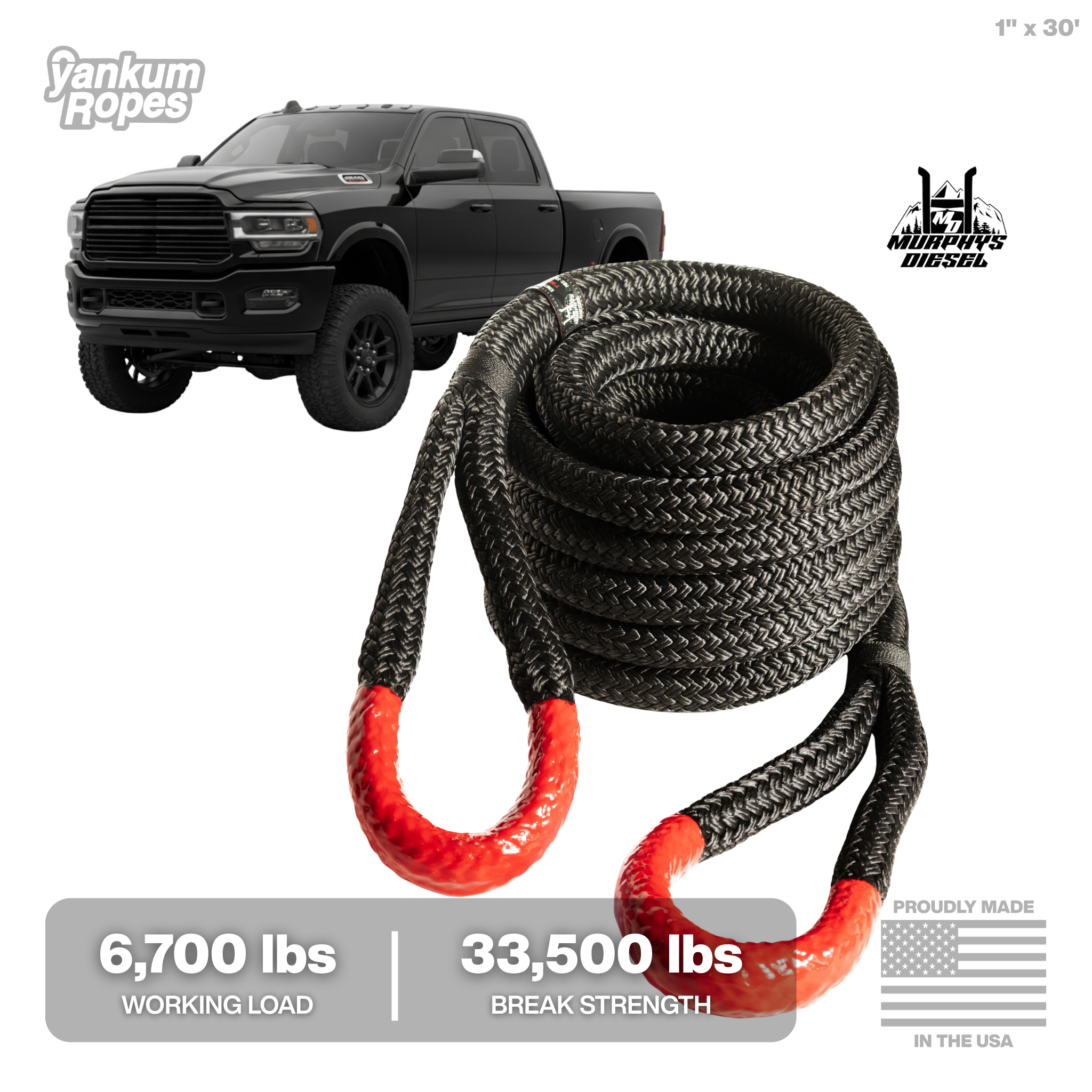
On the spec sheet, that stretch is a real number, not just marketing language. Yankum's 1" rope, the same rating Murphy's uses for its own branded version, "can stretch up to 30% longer when being used," with a minimum tensile strength of 33,500 lbs and a rating for vehicles weighing 7,200 to 10,249 lbs.[1] That's the entire reason a kinetic rope pulls a stuck vehicle free where a rigid chain would just transmit a jolt straight into both frames.
4. Rigging back to a "Holmes tree"
Later in the same recovery, Rick packs up his gear to drag the skid steer's body all the way back to the barn, running both winch lines to the center of the equipment instead of anchoring off a tree for that particular pull. Earlier in the job, though, he does anchor off a tree, and the name he uses for it tells you something about how much this trade runs on tradition.
"You know what that tree's called right there? It's a Holmes tree. Holmes wrecker tree. That's what we call them because Ernest Holmes, he invented like one of the first twin boom wreckers. One of the best wreckers that's probably ever been made. So, you call trees that you anchor to Holmes trees."Wrecker Rick, rigging back to the barn
A "Holmes tree" is what most recovery guides call a dead man anchor. A fixed, solid object, usually a live tree, that takes the load in place of a rated hardware point. The name's Rick's own trade lore. The practice underneath it, using a strong natural anchor when you don't have a rated point handy, is standard rigging.
5. Winch line and kinetic rope aren't the same tool
| Winch Line | Kinetic Recovery Rope | |
|---|---|---|
| How it pulls | Steady, controlled, motor-driven | Stretches, then snaps back with stored energy[1] |
| Best for | A slow, sustained drag with no runway | A stuck vehicle a second truck can get a run at |
| Needs a second vehicle | No | Yes, a pulling vehicle |
| Good backup for the other | Yes, if the rope's vehicle can't get a runway | Yes, exactly what Rick had in reserve here |
Rick's truck runs a heavy, PTO-driven wrecker winch built into the vehicle itself, not a bolt-on product Murphy's sells. That's the specific rig. The logic underneath it scales down cleanly to your own: a winch does the slow, controlled pulling, and a kinetic rope is what you reach for when a second vehicle can get a run at the job instead, or when the winch needs a minute to get re-rigged.
6. Building the same primary-and-backup setup

1" x 30' kinetic rope, minimum tensile strength 33,500 lbs, WLL 6,700 to 11,200 lbs. Rated for 3/4 to 1-ton trucks and heavy SUVs. Made in the USA by Yankum.
The rope by itself. Enough to start a backup kit for a truck that already carries slings and shackles.

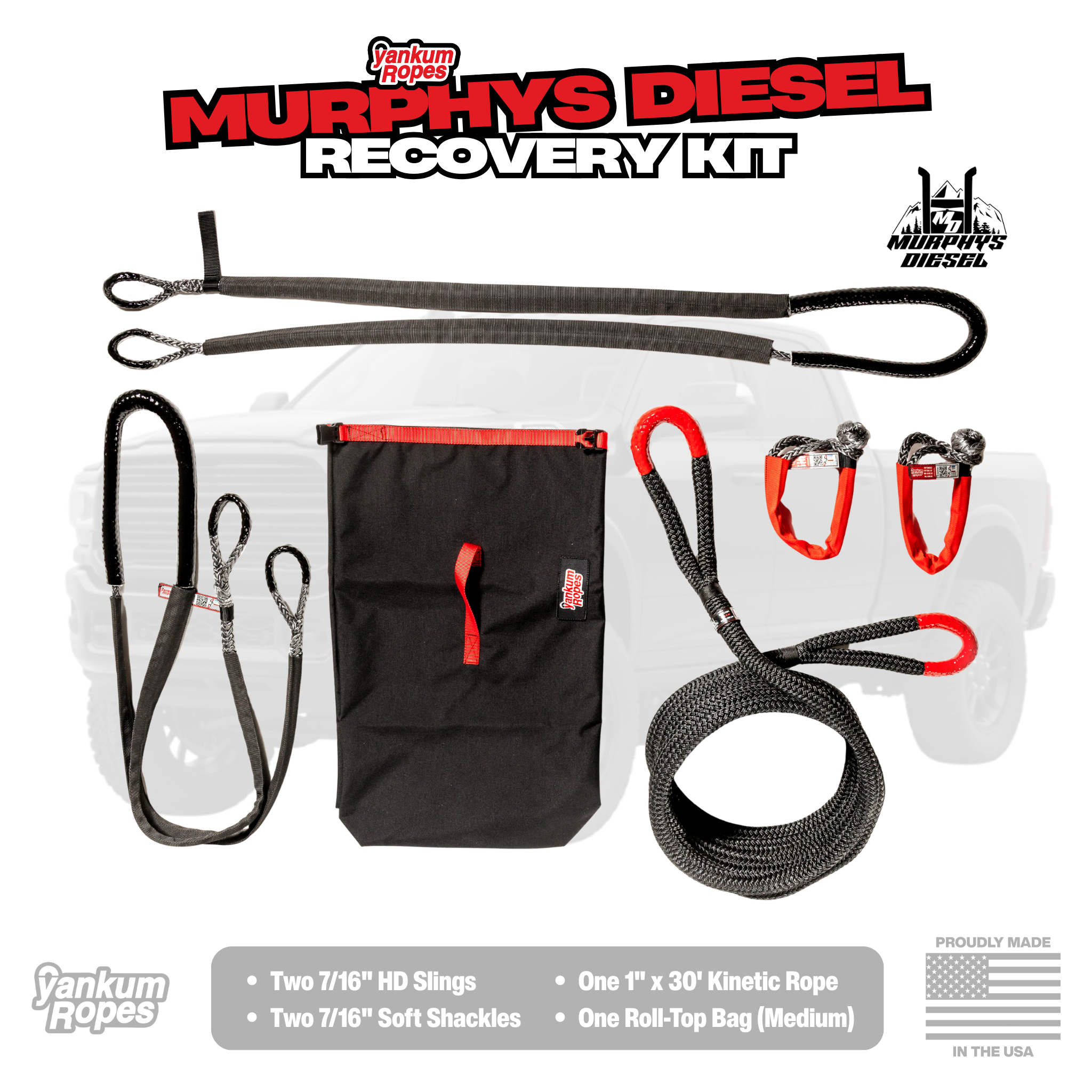
The rope plus two 7/16" recovery slings, two 7/16" soft shackles, and a roll-top bag. Closer to what Rick actually packs.

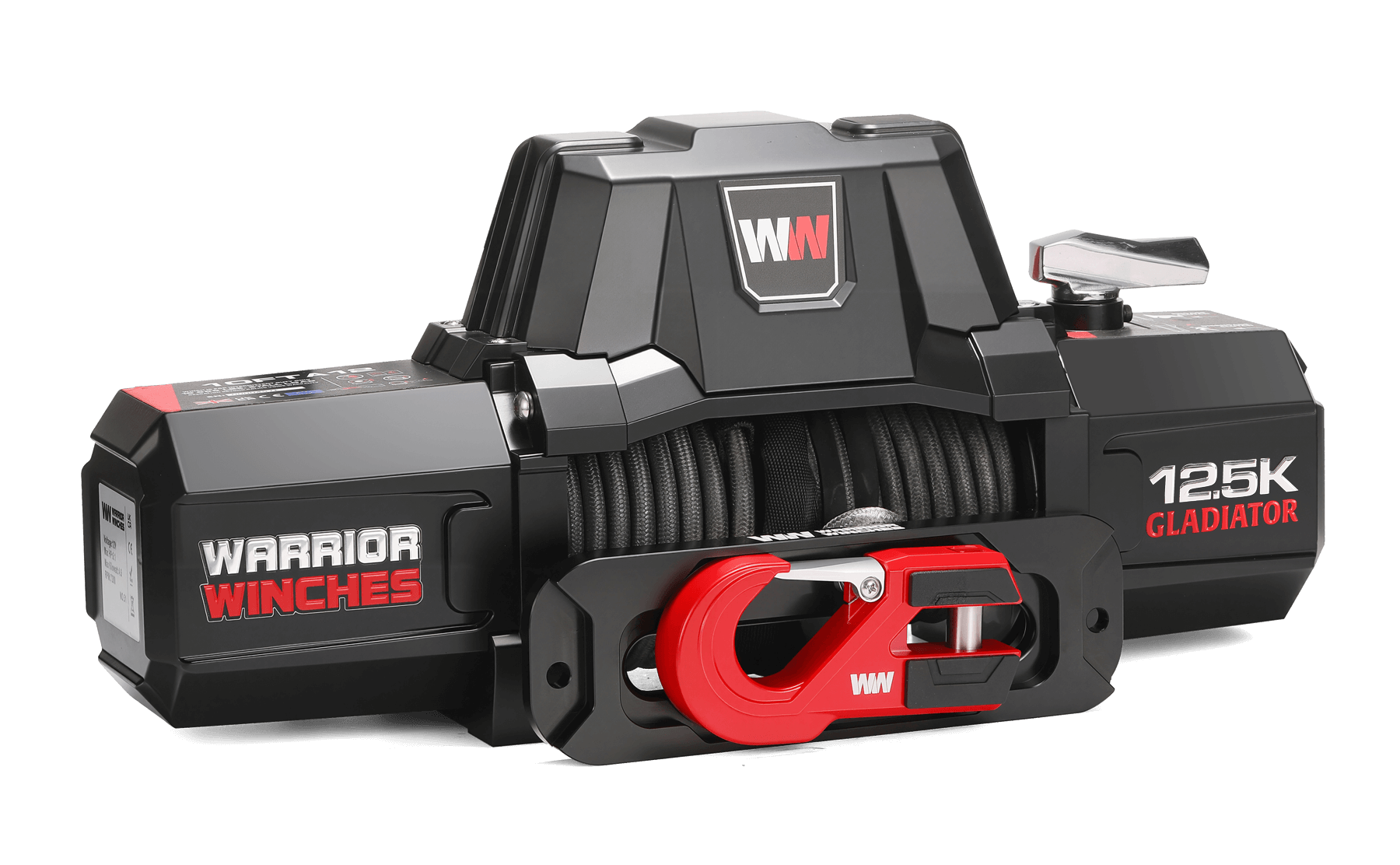
Warrior Winches' 12-volt electric winch with a 7075 aluminum fairlead. The controlled, motor-driven half of the setup, sized for a heavier truck or SUV.
7. Safety: a rope under tension is not a toy
A kinetic rope's whole job is storing energy, which means a failure releases that energy too. Treat every pull like it's loaded. It is.
These come from the rope's own manufacturer and occupational-safety sources, not house opinion.
- Inspect every line before it goes under load, winch cable, kinetic rope, slings, and shackles alike. OSHA's standard is to have a qualified person check for damage or defects before each day's use.[2]
- Never inspect a wire winch cable with bare hands. "Do not inspect a sling by passing bare hands over the wire rope body. Broken wires, if present, may puncture the hands."[2] Gloves, always.
- Respect what the stretch is doing. A kinetic rope's elasticity "ensures that the force is applied gradually, reducing the shock load," but that same stored energy has to go somewhere if a rope, shackle, or anchor fails.[1] Stand well clear of the entire line, not just to the side of it.
- Match the rope to the vehicle. Murphy's rope is rated for 3/4 to 1-ton trucks and heavy SUVs, 7,200 to 10,249 lbs. Don't run it on something well outside that window in either direction.
- Know your backup before you need it. Rick had already worked out his plan B before the winch slipped off the drum. Decide what you'll reach for if your primary system fails before you're standing in the mud figuring it out.
Sources: [1] Yankum: How Kinetic Recovery Ropes Work · [2] OSHA: Safe Sling Use, Wire Rope
8. The bottom line
Rick's winch does the job on this recovery, right up until it doesn't. The kinetic rope never has to come out of the truck. That's the point. A backup only earns its keep by being ready. Not by getting used every time.
Don gets his equipment back, for free, because a 30-year veteran and first responder deserved better than a $30,000 bill. That handoff is exactly why the whole trip happened. The rigging that made it possible wasn't one tool. It was a winch line, a kinetic rope held in reserve, and the rated hardware to connect either one when the job called for it.
Sources
- Yankum, "How Kinetic Recovery Ropes Work." "When the recovery vehicle moves forward, the kinetic rope stretches. This action stores kinetic energy within the rope itself," releasing it "in a smooth and powerful pull"; "elasticity of the rope ensures that the force is applied gradually, reducing the shock load on both vehicles." Stretch and breaking-strength figures from the Rattler 1" kinetic rope product page: "can stretch up to 30% longer when being used," minimum tensile strength 33,500 lbs, rated for vehicles weighing 7,200 to 10,249 lbs. yankum.com/pages/how-kinetic-recovery-ropes-work
- OSHA, "Safe Sling Use: Wire Rope." "Do not inspect a sling by passing bare hands over the wire rope body. Broken wires, if present, may puncture the hands." Also: designate a qualified person to inspect slings and fastenings each day before use. osha.gov/safe-sling-use/wire
FAQ
A kinetic recovery rope is built to stretch under load, storing energy and releasing it as a smooth pull instead of a sudden jerk. A standard tow strap or chain has little to no stretch, so it transmits shock straight into both vehicles instead of absorbing it.
A winch and a kinetic rope solve different problems. A winch does a slow, controlled pull with no second vehicle needed. A kinetic rope needs a second vehicle that can get a run at the job, but it's a fast backup if the winch needs to be re-rigged or isn't an option. Rick's own winch line slipped off the drum mid-recovery in this episode, which is exactly the kind of moment a backup plan matters.
Yankum's 1 inch kinetic rope, the same class Murphy's sells under its own name, can stretch up to 30% longer under load. That stretch is what stores the energy that helps pull a stuck vehicle free, and it's also what keeps the pull gradual instead of a sudden shock on both trucks.
It's a fixed, solid object, usually a live tree, used as an anchor point in place of rated hardware. Rick calls these 'Holmes trees' after Ernest Holmes, who invented one of the first twin-boom wreckers; it's trade slang, not an official term, but the anchoring practice itself is standard.
The kinetic ropes Rick mentions keeping in reserve are his own gear, not confirmed on camera as Murphy's branded product. Murphy's sells the same class and rating of rope, made by the same supplier, Yankum, that Rick's own kit uses.
Make sure both lines share the load evenly at the connection point and that the point itself is rated for the combined pull, not just one line's worth. Inspect both lines before they go under tension and keep everyone clear of the full path of both cables, not just one side.
Match the rope's rated vehicle weight to your truck's actual weight, not just its class. Murphy's recovery rope is rated for vehicles weighing 7,200 to 10,249 lbs, which covers most 3/4-ton to 1-ton trucks and heavy SUVs. Check your own curb weight plus gear before assuming a size.