
A build sheet is just a parts list, and if you skip past the fireplace and the chef's set, Rick's F550 giveaway build reads like a recovery-gear shopping list. Winch on the front. Winch on the back. Shackle points on an oversized hitch. A recovery rope kit. Rick reads the whole thing off on camera the day he hands the truck to its new owner. Which of those are real, buyable recovery gear? Which one does Murphy's not sell? And what happened when the crew drove into Mexico to pick up the truck's bumper themselves? Pulling it apart, line by line.
- Rick's F550 giveaway build ran a winch front and rear, a replacement bumper, Carli mid-travel suspension, shackle points on a big rear hitch, and a recovery rope kit.
- Murphy's doesn't sell the bumper or the suspension. It does sell the rope kit and the hitch-mounted recovery point behind those "shackle points."
- A recovery rope kit already bundles the rope, two slings, and two soft shackles that the build sheet lists as separate items.
- A rated hitch receiver recovery point is built for a straight-line pull. The one Murphy's sells carries its own warning: pull in line, never to the side.
- Getting the front bumper meant a trip to the factory in Agua Prieta, Mexico, where local police nearly held onto the crew's cameras.
1. What "Freedom 550" actually got built
It's giveaway day, and Rick's walking the finished F550 in front of its new owner, reading the build sheet like a receipt. Michael Travis and his family show up at the shop. Rick runs through what the truck came with: "Got you a winch on the front, replacement bumper, Carli mid-travel suspension. Got all the kids. Got a winch on the back. Here's your recovery rope kit, fireplace, refrigerator." The fireplace, the refrigerator, and the chef's set that follow are camper-build extras. The first five items are recovery and suspension gear. That first half is what's worth turning into a shopping list.
None of it happened in the order Rick reads it off on giveaway day, though. Rewind, and his crew is still cutting a hole in the truck bed for the rear winch mount, fabricating a winch plate from scratch, and driving south of the border for a bumper that couldn't just be shipped. A real build happens piece by piece, the way you'd expect. There are always a few detours nobody planned for.
2. The parts that matter, and the one that doesn't ship from here
Two items on that build sheet aren't something Murphy's can sell you. Say so before anything else. The replacement bumper came from an off-road bumper builder Rick drove to Mexico to pick up in person. The Carli mid-travel suspension is a name-brand suspension kit that was part of the same build. Both are real parts of what Rick built. Say it twice if it needs saying twice. Neither one is something you can buy from this store, so nothing here should read like it is.
What's left is the recovery half: a winch mounted front and rear, "shackle points" on an oversized rear hitch, and a recovery rope kit. That's what maps onto what Murphy's actually stocks. Standing at the finished rear winch mount, Rick points right at the hardware and says exactly what it's for.
"This is my rear winch mount. Shackle points. Look at the size of that hitch."Wrecker Rick, walking the finished build
"Shackle points" is Rick's shorthand for a hitch built to take a rigging load, not just tow a trailer. That's the exact job a rated hitch receiver recovery point is built for. It's the piece of this build sheet with the most direct match in the store.
3. What a rated recovery point does that a bumper hitch doesn't
A tow-ball hitch is rated to pull a trailer in a straight line at low load. A rated recovery point is a different animal: it's built for a winch or a rope under real tension. Murphy's 2 1/2" Hitch Receiver Recovery Point is CNC machined in Idaho from 6061 aluminum, rated to a working load limit of 18,000 lbs at a 5:1 factor of safety, with a minimum breaking strength of 66,400 lbs. Stout numbers. Compact hardware, too. It's built to accept a 7/8" bow shackle pin, and its edges are chamfered so a soft shackle up to 7/16" doesn't chafe against the metal.
The product page carries its own warning: pull in line with the hitch, never to the side. That's the single most common mistake in home recovery rigging, and it's an easy one to make. A recovery point is engineered for a straight pull. Angle the load, and the hardware's taking stress it was never designed for, whatever the WLL sticker says. One thing it doesn't come with: a receiver pin. That's a separate buy if you don't already have one.
4. The recovery rope kit vs. building it piece by piece
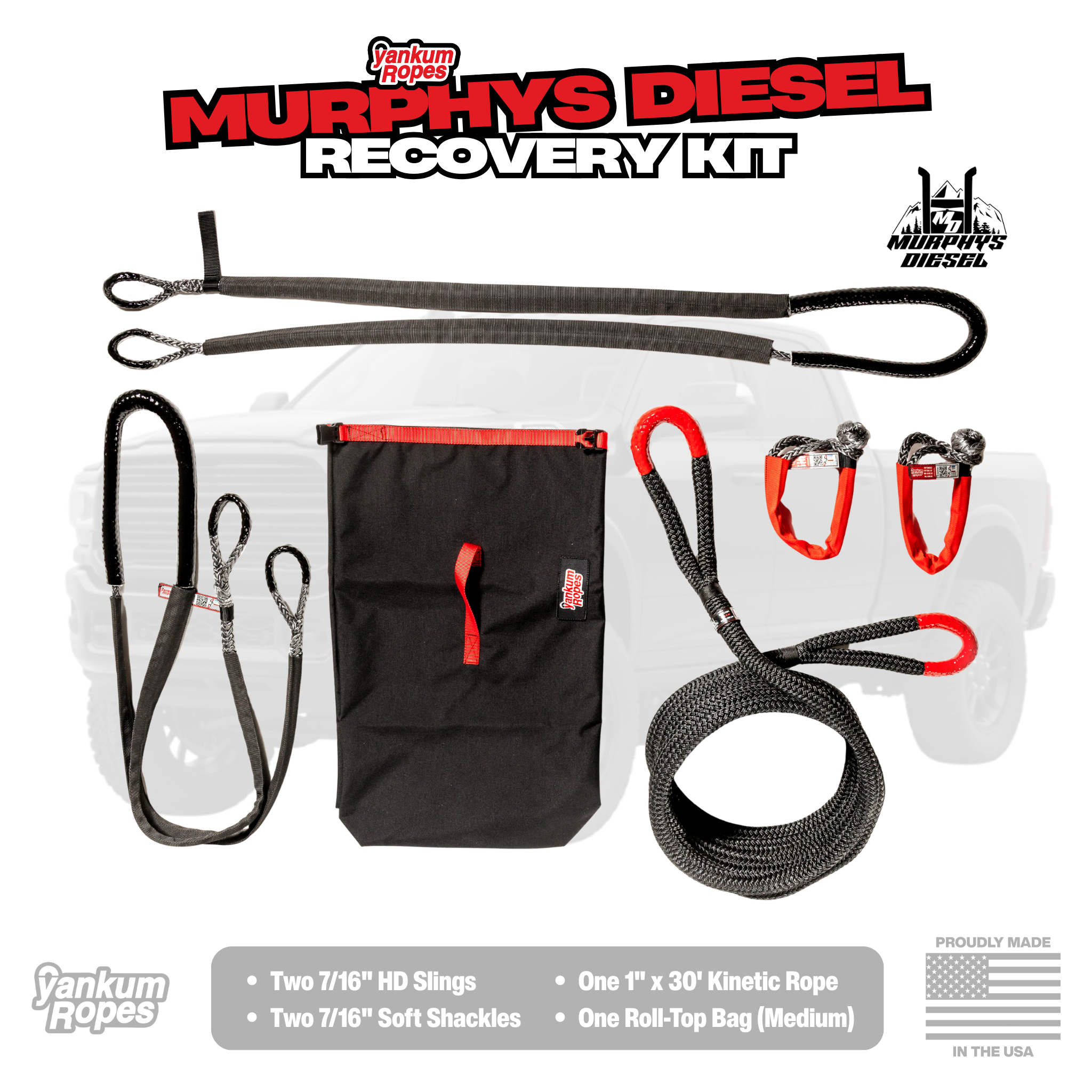
Rick's build sheet lists "recovery rope kit" as one line, but a real kit is four pieces working together. The Murphys Diesel Recovery Kit is built with Yankum. Actual inventory: the 1" x 30' kinetic rope, branded for the truck. Two 7/16" heavy-duty recovery slings, for wrapping axles, control arms, or frame rails. Two 7/16" soft shackles that won't chew up paint the way a steel shackle can. And a water-resistant roll-top bag to keep the whole thing together in a truck bed.
| Rope + Hitch Point Only | Recovery Kit | |
|---|---|---|
| Price | $269.99 + $177.99 | $795.94 |
| Kinetic rope | 1" x 30', 33,500 lb breaking strength | Same rope, Murphys Diesel branded |
| Recovery slings | Not included | Two 7/16" heavy-duty slings |
| Soft shackles | Not included | Two 7/16" soft shackles |
| Storage | Not included | Roll-top Yankum bag |
The rope alone is rated for vehicles between 7,200 and 10,249 lbs, the range Yankum calls three-quarter-ton to one-ton trucks and heavy SUVs. Buy the rope and the hitch point separately, and you've got a working recovery setup. That's for the cost of those two items combined. No slings, though. No shackles either. Those are what the kit throws in. The kit costs more up front. What that gets you back is a system already matched to work together, hardware chosen to fit the rest of the rig instead of bought piece by piece and hoped into place. Closer to what "shackle points" on a real build actually means.
5. The bumper run that went sideways in Mexico
Instead of having the new bumper shipped, Rick drives to the factory in Agua Prieta, Mexico, to pick it up himself. "I wanted to go down to old Mexico. I was looking for an adventure," he says on camera, and for a while that's exactly what it is: a factory tour, a look at how many bumper styles the builder offers, a straightforward pickup.
Then a crew member starts filming somewhere they weren't supposed to. Bad move, and it's about to get worse before it gets better.
"We got Mexican... Mexican police. Just about got thrown in the hoosegow for filming. You're not allowed to film that."Wrecker Rick's crew, at the crossing in Agua Prieta
Tense couple of minutes, and a little crazy for a bumper run. They don't get arrested, though. Rick says on camera the officers recognized him and let the group go, which he chalks up to "who you know, folks." It's the detail that never makes it onto a build sheet, and it's exactly why he calls this the build that almost got him arrested rather than just the build.
6. Build your own checklist
Pulling the recovery half of this build sheet into your own truck? Start with the anchor point and work outward. A hitch receiver recovery point is the cheapest entry. The rope on its own covers the pull. The full kit covers the pull and the rigging hardware to go with it.

Built with Yankum. 1" x 30' kinetic rope, two 7/16" recovery slings, two 7/16" soft shackles, and a roll-top storage bag. Rated for 3/4 to 1-ton trucks and heavy SUVs.
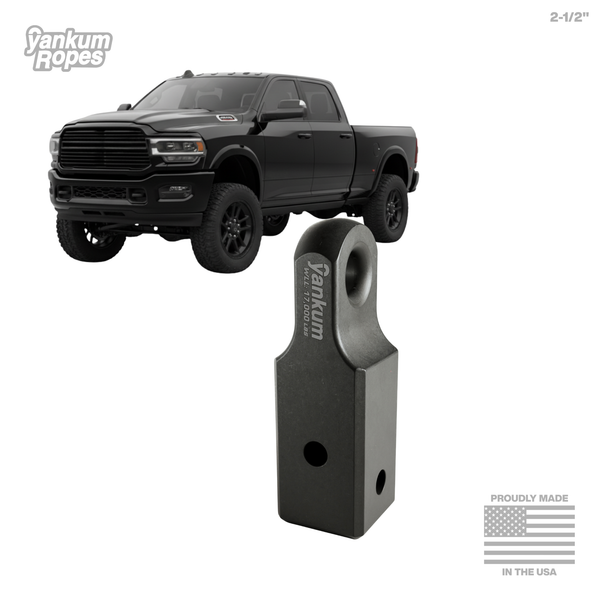
The "shackle points" Rick's build is talking about. WLL 18,000 lbs at 5:1 FOS. CNC machined in Idaho from 6061 aluminum. Made in the USA.

1" x 30', 33,500 lb breaking strength. Rated for 7,200 to 10,249 lb vehicles. Made in the USA.
The rope plus two 7/16" slings, two 7/16" soft shackles, and a roll-top bag. Everything matched to work together.
7. Safety: rigging you can actually trust
Every piece of hardware in a recovery pull is only as trustworthy as its last inspection. Shackle points, rope, slings. They all fail the same way: quietly, until they don't.
These aren't suggestions. Each one is standard guidance from rigging and safety sources, not house opinion.
- Pull in line with the hitch, never to the side. Murphy's 2 1/2" Hitch Receiver Recovery Point is rated and labeled for a straight pull only. A side load stresses hardware in a direction it wasn't built for.
- Inspect every piece of rigging before each use. OSHA's guidance for wire rope and slings is to designate a qualified person to check "slings and all fastenings and attachments each day before use for damage or defects," watching for broken wires, severe abrasion, kinking, heat damage, corrosion, and deformed end attachments. Any of those, and it comes out of service.
- Keep everyone clear of the line while it's under tension. OSHA is specific here too: "personnel never stand in line with or next to the legs of a sling that is under tension," and no one stands or passes underneath a suspended load. A recovery rope under load follows the same rule.
- Match your shackle pin to the hardware. The hitch point above fits a 7/8" bow shackle pin and soft shackles up to 7/16" without chafing. A mismatched pin is a loose connection waiting to happen.
- A recovery point isn't a tow ball, and the two don't swap for each other. One is rated for the straight-line load of a winch or rope pull. The other isn't, regardless of how solid it looks bolted to the bumper.
Sources: [1] OSHA, wire rope sling safety guidance · [2] Murphy's Diesel, 2 1/2" Hitch Receiver Recovery Point product page
8. The bottom line
Half of Rick's build sheet is a shopping list for Murphy's. The other half, the bumper and the suspension, isn't. Fine to say plainly. The store carries the anchor point and the rigging to use it right, starting with the 2 1/2" Hitch Receiver Recovery Point at $177.99, the Murphys Diesel Recovery Rope at $269.99, or both plus slings and shackles in the Murphys Diesel Recovery Kit at $795.94.
Michael Travis got the whole build, bumper and Carli suspension included, for free. Everyone else pays for the recovery half at these three prices. For the Mexico bumper run, you're on your own.
- OSHA, safe sling use guidance for wire rope slings. "Designate a qualified person to inspect slings and all fastenings and attachments each day before use for damage or defects." / "Ensure that personnel never stand in line with or next to the legs of a sling that is under tension" and "do not stand or pass under a suspended load." osha.gov/safe-sling-use/wire
- Murphy's Diesel, 2 1/2" Hitch Receiver Recovery Point product page. WLL 18,000 lbs (5:1 FOS), MBS 66,400 lbs, 6061 aluminum, CNC machined in Idaho, fits a 7/8" bow shackle pin, "Pull IN LINE with hitch. DO NOT side pull." murphysdiesel.com/products/2-1-2-hitch-receiver-recovery-point
FAQ
The rope alone is the 1" x 30' kinetic rope, rated for vehicles between 7,200 and 10,249 lbs. The kit wraps that same rope with two 7/16" heavy-duty recovery slings, two 7/16" soft shackles, and a roll-top bag to carry it all.
It's a rated anchor point that pins into your hitch receiver. A winch line or rope gets something built for the load to hook to, instead of a tow ball or bare bumper that was never rated for it.
No. Murphy's 2 1/2" Hitch Receiver Recovery Point is built and labeled for a straight, in-line pull. Loading it from the side puts stress on hardware that isn't rated to take it that way.
No. Both came from other builders as part of that specific giveaway truck. Murphy's stocks the recovery half of the same build: the rope, the hitch point, and the kit that bundles both with slings and shackles.
Yankum rates it for vehicles between 7,200 and 10,249 lbs, roughly the three-quarter-ton to one-ton truck and heavy SUV range.
He drove to the bumper builder's factory in Agua Prieta to pick it up in person instead of having it shipped. A crew member filmed somewhere they weren't supposed to, local police stopped the group, and they were let go after being recognized.